
Level One: Lighting Trained
-
Register
- Non-member - $295
- Member - $295
Level One: Lighting Trained
Fundamentals of Lighting and Controls
Free with NEMRA Lighting Membership, Level One course is the perfect starting point for lighting newcomers or those refining their expertise. This essential foundation builds a clear understanding of core lighting concepts, control strategies, industry terminology, and how lighting systems work together. Each module is designed to strengthen your confidence in communicating with distributors, contractors, and specifiers, ensuring you can participate in professional discussions. Because later stages of the curriculum build on this knowledge, completing Level One gives you the vocabulary and insight to approach more advanced topics with curiosity, competence, and a deeper appreciation for lighting.
-
Contains 9 Component(s)
Seven modules to build lighting vocabulary and learn concepts relevant to the entire industry.
Welcome to Introduction to Lighting!
Introduction to Lighting was developed by Dan Blitzer, Principal of The Practical Lighting Workshop, and the Illuminating Engineering Society education team to provide a fast-paced and practical understanding of lighting vocabulary, equipment, regulations, and practices. No prior lighting experience is required. A minimum time is required for each video to unlock the next one in the series.
Learning Objectives
The overall objective of the course is a broad introduction to the technology and practice of lighting with emphasis on recognizing and applying lighting principles and technical terminology.
1. Explore the physics and interaction of light and human vision.
2. Explain the key terminology and attributes of light source families and types.
3. Describe the attributes and applications of luminaires.
4. Describe the attributes and applications of lighting controls.
5. Identify the codes, regulations, and standards that govern and guide lighting practice.
6. Survey lighting economics and maintenance strategies.Seven Parts:
1: How We See
2: Light Generation
3: Light Sources
4: Directing Light
5: Controlling Light
6: Lighting Codes and Standards
7: Maintaining Lighting Systems
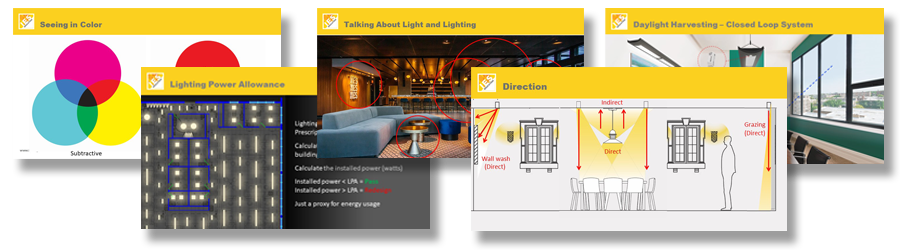
-
Contains 2 Component(s), Includes Credits Recorded On: 03/16/2020
In this lecture-format video, enjoy a comprehensive look at various aspects of the color of light, and the impact on the objects that we see.
About this Course
The IES provides insight and access to the work being done in some of the best lighting educational facilities, through the Lighting Education Facility Showcase (LEFS). These videos feature students and faculty and capture a wide range of lighting topics and facility-specific features. White Lighting and Color Appearance is a LEFS video from New York School of Interior Design. Description: In this lecture-format video, enjoy a comprehensive look at various aspects of the color of light, and the impact on the objects that we see. Topics include the science and history behind CCT, CRI and TM-30 as well as their strengths and limitations. Learn how to identify the important color shifts and spectral variations of a light source, and see demonstrations of each.
-
Contains 4 Component(s), Includes Credits
A uniquely curated series, these presentations focus on how we perceive light, and the language used to describe specific lighting outcomes.
About this Course
The IES provides insight and access to the work being done in some of the best lighting educational facilities, through the Lighting Education Facility Showcase (LEFS). The four engaging videos in this compilation were filmed in three different facilities. Description: A uniquely curated series, the presentations in this compilation provide a look into how we perceive light, and the language we use to describe it. To develop lighting concepts, it is important to understand how we perceive light, and the methods of applying light to achieve specific outcomes. Included in this compilation is a series of three videos; Richard Kelly's Elements and Light Distribution filmed at Parsons - The New School in NYC, Volume of Light filmed at the New York School of Interior Design, and Accent Ratios - Playing with Luminance to Create Contrast filmed at the University of Colorado - Boulder. These videos can be watched in an order you choose, but we recommend watching them in the order they're shown.
Learning Objectives:
By the end of this course learners will be able to...
1. Describe Richard Kelly's Three Functional Elements of Light.
2. Explore the purpose of light in different applications, and ways to mitigate undesired effects, like glare and unintended contrast.
3. Discover and describe the balance of luminance and illuminance in lighting design.
4. Develop a language of light from which to draw upon to create thoughtful lighting concepts. -
Contains 2 Component(s), Includes Credits
Shaun Fillion provides an under-the-hood look at radiosity calculations and raytrace renderings. We take look at the methodology used by photometric calculation software to represent the performance of lighting in the built environment, tracking it from the roots of the Lumen Method and Inverse Square Law.
About this Course
The IES offers Educational Webinars throughout the year, purposefully spanning a broad range of topics and speaker expertise. This was a live webinar, now available as an archived webinar and CEU course.
Description: Shaun Fillion provides an under-the-hood look at radiosity calculations and raytrace renderings. We take look at the methodology used by photometric calculation software to represent the performance of lighting in the built environment, tracking it from the roots of the Lumen Method and Inverse Square Law. Visual representations of illuminance versus luminance are also covered. The seminar also diagnoses and tweaks example models to make the lighting calculations more accurate. By the end of this course learners will be able to...
1. Interpret elements of calculations including units of light, anatomy of calculations, and IES files.
2. Explore the lumen method and point method compared to photometric calculations.
3. Identify the impact of different variables in lighting and how they impact calculations (daylighting, color temperature, etc.)
4. Describe the limitations of IES files in calculations. -
Contains 4 Component(s), Includes Credits
Light is a fundamental element of our existence, but we need to learn a second language of light if we are to share this amazing gift with the world. Join David K. Warfel for a romp through the lighting industry where no one is safe from over-simplification and pithy remarks but where everyone can laugh a little and see the proverbial light at the end of the tunnel.
About this Course
We are all in sales of some kind. Designers sell ideas and concepts that require the sale of light fixtures. Engineers lay out precise solutions that require the purchase of product and the labor of installation. Manufacturers create lighting products that must sell to keep the doors open and food on the table. Client and customer comments like the one above may strike fear in your heart, and it should. Lighting is not often an easy sell. Someone else does it faster, cheaper, or better so hurry up, lower your prices or fees, and improve your game. The end user doesn’t want what we have and would rather not pay for it. Nobody cares about our calculations but us and lawyers, the client does not know TM-30 from R2-D2, and the only thing selling like hotcakes are the glare bombs shaped like them. Now for the good news: you are the keeper of a sacred ancient magic that has the power to transform lives. Life depends on this magical force. Light is a fundamental element of our existence, but we need to learn a second language of light if we are to share this amazing gift with the world. Join David K. Warfel for a romp through the lighting industry where no one is safe from over-simplification and pithy remarks but where everyone can laugh a little and see the proverbial light at the end of the tunnel. And it is brighter than ever.